The unseen work of bringing people together
A lot of the work we do isn’t really seen.
You might see the occasional social media post.
Sometimes a photo of families enjoying an activity in a park.
Every now and again an impact report.
What you don’t see are the conversations that happen beforehand — and the dozens more that follow once people start connecting the dots.
The booking forms.
The introductions between people who should probably know each other.
The small pieces of coordination that make things possible.
That part rarely makes it onto a poster.
—
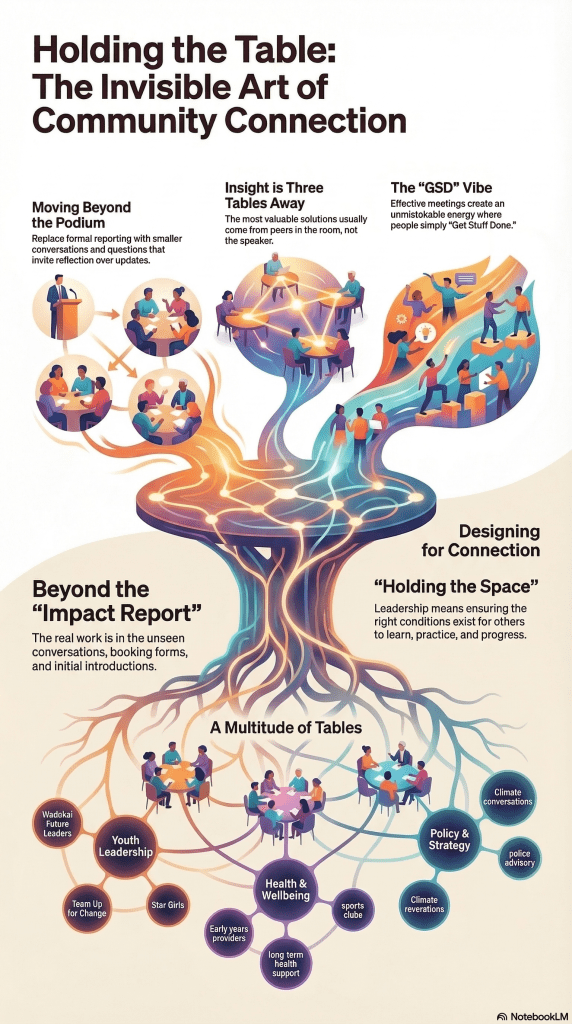
A lot of tables
Over the years we’ve hosted and facilitated quite a few different networks.
Early years providers.
Sports clubs.
Informal physical activity groups.
Organisations supporting people with long-term health conditions.
And several youth groups too.
Groups like Wadokai Future Leaders, Team Up for Change, and Star Girls, where young people are beginning to shape conversations about the places they live.
And that’s just the networks we host.
We also attend many more.
Food networks.
Financial inclusion partnerships.
Literacy initiatives.
Cultural organisations.
Climate conversations.
Police advisory groups.
Strategy, policy and funding boards.
All slightly different, as you’d expect.
But when you step back and look at it, it adds up to a lot of tables.
—
Where things start to happen
Network meetings don’t sound particularly exciting.
But they’re often where interesting things begin.
They’re the moments where people who usually work in parallel find themselves in the same room and realise they’re trying to solve similar problems.
They’re opportunities to ask simple questions:
What’s happening right now?
Where’s the energy?
What could we do together?
Sometimes that’s where the magic appears.
Sometimes it’s just a small idea that someone takes away and turns into something bigger.
And occasionally you feel that unmistakable moment where a room fills with people who simply get things done.
The GSD vibe.
If you know, you know.
—
Making meetings worth the time
People are busy.
So we’re very conscious that network meetings shouldn’t exist just for the sake of existing.
Nobody needs another meeting.
When we host one, it matters to us that people leave feeling it was worth their time.
That they learned something.
That they met someone new.
That they discovered an opportunity they didn’t know existed.
That something shifted — even slightly.
—
Not just waiting your turn to talk
We also try not to create spaces where everyone is simply sat waiting for their turn to talk.
That format has its place. Occasionally it’s useful to hear updates from around the room.
But more often we design these gatherings differently.
Smaller conversations.
People moving around the room.
Questions that invite reflection rather than reports.
The aim isn’t just to share information.
It’s to help people learn from each other.
Because the most valuable insight in the room rarely comes from the person at the front.
It usually comes from someone sitting three tables away who has already solved the same problem.
—
Holding the space
In martial arts there’s an idea that leadership isn’t always about standing at the front.
Sometimes it’s about holding the space.
Making sure the conditions are right for everyone else to learn, practise and progress.
The same idea applies here.
Sometimes leadership simply means holding the table.
Making sure the right people are invited.
Making sure the conversation happens.
And making sure the space exists for ideas to take shape.
—
The real work of place
Because most of the time, the real work of place doesn’t happen in strategies or reports.
It happens when people sit down together and start figuring things out.
And sometimes the most important thing anyone can do is simply make sure that table is there.
 Northern Ambiguity
Leave a comment