
Why short-term money fails communities
I didn’t really understand funding until I had to make payroll.
For years, I worked on the funder side — holding budgets, shaping programmes, distributing money. It was secure. Strategic and operational, but still at arm’s length.
The risk never quite landed with me in the same way. I wasn’t worrying about payroll, or whether the next contract kept the doors open.
I run several companies and social enterprises myself. I have done for many years
Most are self-sustaining — loyal customers, earned income, no grants needed.
But one isn’t like that.
It provides the things that are hardest to fund:
the unglamorous work,
systems,
relationships,
people infrastructure.
The scaffolding that makes everything else possible — but never makes the brochure.
You can’t easily photograph trust.
You can’t put “governance capacity” on Instagram.
No one shares a post about steady, behind-the-scenes coordination.
And it’s forced me to see funding very differently.
Because too much of it behaves like hit-and-run.
The failure of hit-and-run funding
Across community, sport, and social impact work, funders often talk about systems change. But short-term funding models create fragile cycles that prioritise compliance over transformation.
On paper, activity happens.
In practice, continuity breaks.
Communities feel that break most.
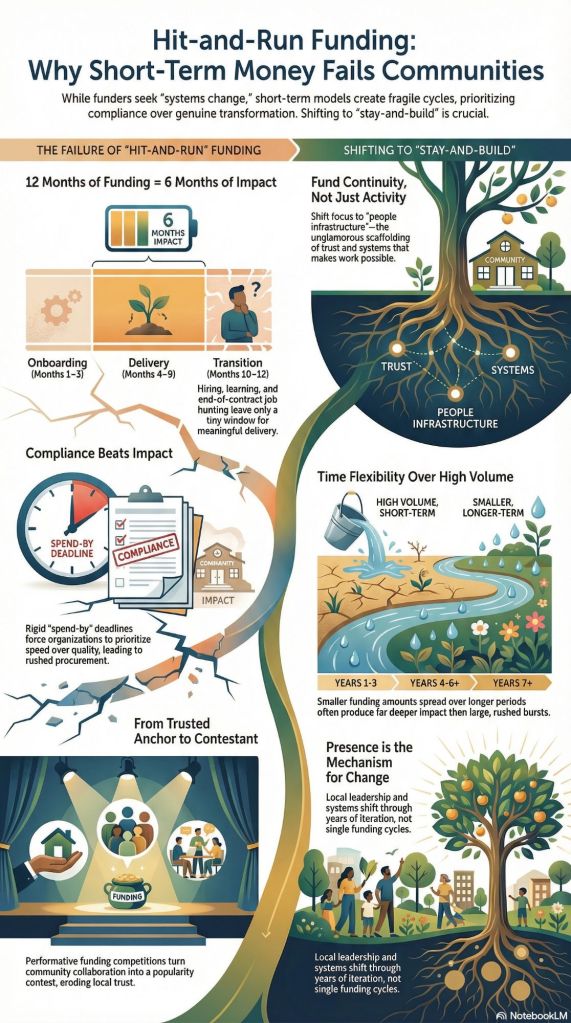
12 months of funding = 6 months of impact
A common pattern is the one-year funded role.
In reality, that timeline looks like this:
- Months 1–3: onboarding, learning, relationship-building
- Months 4–9: meaningful delivery
- Months 10–12: job insecurity, transition, exit
So a 12-month grant produces roughly six months of stable impact.
Just as trust builds and systems start to settle, the person leaves — or prepares to.
Residents experience churn.
Organisations avoid investing deeply.
Learning resets.
We call this capacity building.
Communities often experience it as turnover.
When compliance beats impact
Another form of hit-and-run funding is rigid spend-by deadlines.
The intention is administrative.
The effect is distortion.
Organisations are forced to prioritise speed over quality:
- rushed procurement
- short-term hires
- activity spikes instead of sustained provision
- equipment without systems
- programmes before relationships
Money moves quickly.
Impact embeds slowly.
So compliance wins.
Even though smaller amounts over longer periods would often achieve far more.
From trusted anchor to contestant
A newer trend asks organisations to publicly campaign for votes, clicks, or likes — with no guarantee of funding.
Groups must mobilise communities online, compete visibly with peers, and perform need in public spaces.
This shifts them from:
trusted local anchor
to
contestant in a popularity contest
It erodes collaboration, strains relationships, and consumes scarce time and dignity.
Place systems are built on trust.
Competitive spectacle undermines it.
The hard edge of hit-and-run: social care and local government
We see another, harsher version of hit-and-run funding playing out in local government finance — and nowhere is it clearer than in social care.
In places like Hartlepool, social care costs are now consuming an ever-greater share of council budgets. The system itself is widely acknowledged to be under strain: fragmented provision, escalating fees, and private operators — including large financial investors — extracting profit from the care of some of our most vulnerable citizens.
We have an absolute moral duty to care for one another.
But it is profoundly troubling that communities already facing deep deprivation are also expected to absorb the financial shock of a failing national care system.
Local authorities are left balancing statutory obligations against shrinking discretionary capacity. The result is a squeeze that crowds out prevention, community investment, and the very place-based work that reduces long-term demand in the first place.
This too is hit-and-run funding — just at system scale.
Short-term settlements.
Unpredictable allocations.
Rising demand without structural reform.
Councils are pushed into reactive crisis management rather than planned, dignified stewardship of place.
Central government has it within its power to change this.
It can:
- cap excessive care costs and profit extraction
- reform funding so high-need areas receive equitable support
- stabilise local government finance over multi-year horizons
- enable councils to meet statutory duties without hollowing out place
Done well, this is not charity to struggling towns.
It is fairness.
It allows places to maintain dignity — not repeatedly return to Westminster with a begging plate.
Because when the core system is unstable, every other form of place investment becomes fragile too.
Prevention weakens.
Community capacity erodes.
Trust thins.
And all the long-term, stay-and-build work that communities and local partners are doing is undermined by structural volatility they cannot control.
Shifting to stay-and-build
If the goal is real place change, funding must shift from activity to continuity.
Not just programmes — people infrastructure.
Not bursts — presence.
Not projects — systems.
The most valuable local assets are rarely tangible:
- trust
- relationships
- credibility
- coordination
- local knowledge
These are exactly what short-term funding destabilises.
Time flexibility beats high volume
Place change compounds over time.
Three years of modest, steady funding will almost always produce deeper outcomes than one year of high-volume spend.
Because:
Year 1 builds relationships.
Years 2–3 stabilise systems.
Years 4–6 embed culture.
Years 7+ sustain outcomes.
Short bursts rarely reach embedding.
Long presence does.
Presence is the mechanism for change
Communities do not change in funding cycles.
They change through consistent presence — familiar people, stable relationships, iterative learning.
Local leadership develops over years.
Participation grows gradually.
Systems shift through repetition.
Presence is not a soft factor.
It is the mechanism.
From hit-and-run to stay-and-build
The difference between transactional and transformational funding is simple:
One funds activity.
The other funds continuity.
If funders genuinely seek systems change, funding design must match how systems actually change.
That means fewer hits.
And far more staying.
 Northern Ambiguity
Leave a comment