
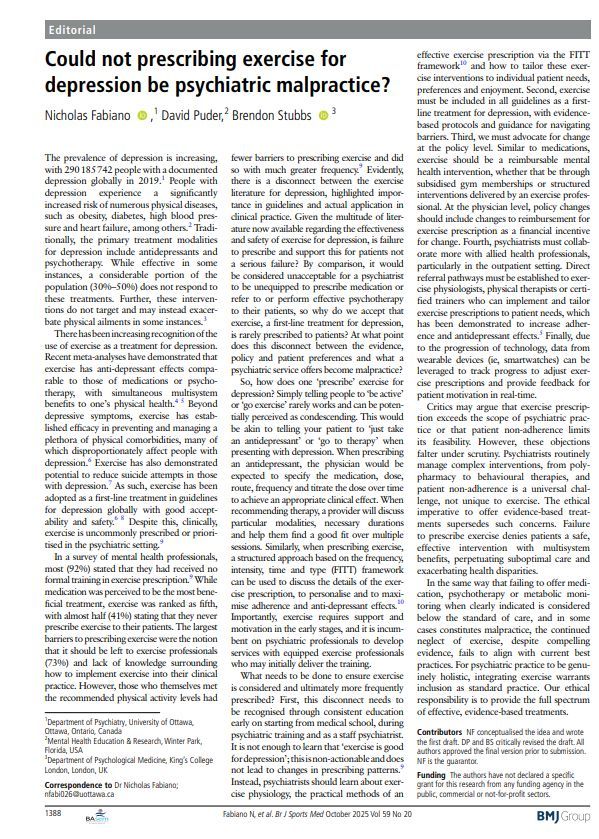
I think the editorial is really valuable.
But I’d caution against conflating exercise and movement.
For someone who’s sedentary or struggling, they don’t need exercise first — they need movement.
Exercise comes later.
There’s a difference.
Exercise is structured, prescribed, often supervised.
Movement is simply stepping outside, walking, chatting, playing, being present in the world again.
For someone feeling fragile, that first step is the hardest part.
And that step isn’t a clinical problem — it’s a place problem.
If streets feel unsafe, parks feel neglected, or spaces look abandoned, people simply won’t go out.
No prescription changes that.
When you’re low, the world feels riskier. Environment matters more, not less.
So before we talk about exercise as treatment, we have to talk about whether a place feels safe enough to move in at all.
That’s where trusted “place makers” matter.
The people who animate parks, open spaces, the prom, estates — the familiar faces who create a sense of safety and belonging. The informal “come and join us” layer.
They’re not delivering fitness sessions.
They’re lowering the activation energy required to leave the house.
In practice, that’s what makes everything else possible.
Because once someone is moving regularly and socially, then structured exercise can genuinely help.
Without that foundation, exercise prescriptions often land too early and miss the people who need them most.
So for me, it’s a sequence:
Place → movement → routine → confidence → exercise → clinical benefit.
Not the other way round.
We’ve also noticed some friction when trying to fund physical or movement-based interventions through clinical pathways.
Not because people don’t believe in them — most clinicians absolutely understand the value — but because health systems are organised around defined remits, targets and budgets. Prevention and place-based work often sits between departments rather than neatly inside one.
So it can feel like “not our job”, when really it’s “not clearly in our lane”.
That’s a structural challenge, not a cultural one.
And it’s exactly why partnerships matter.
Healthcare is very good at treating illness.
Place-based organisations are often better positioned to create the everyday conditions that stop people becoming unwell in the first place.
Both roles are essential.
Exercise absolutely has a role.
But movement — enabled by safe, welcoming places and trusted people — is usually the first step.
And without that, prescriptions don’t stick.
 Northern Ambiguity
Leave a comment